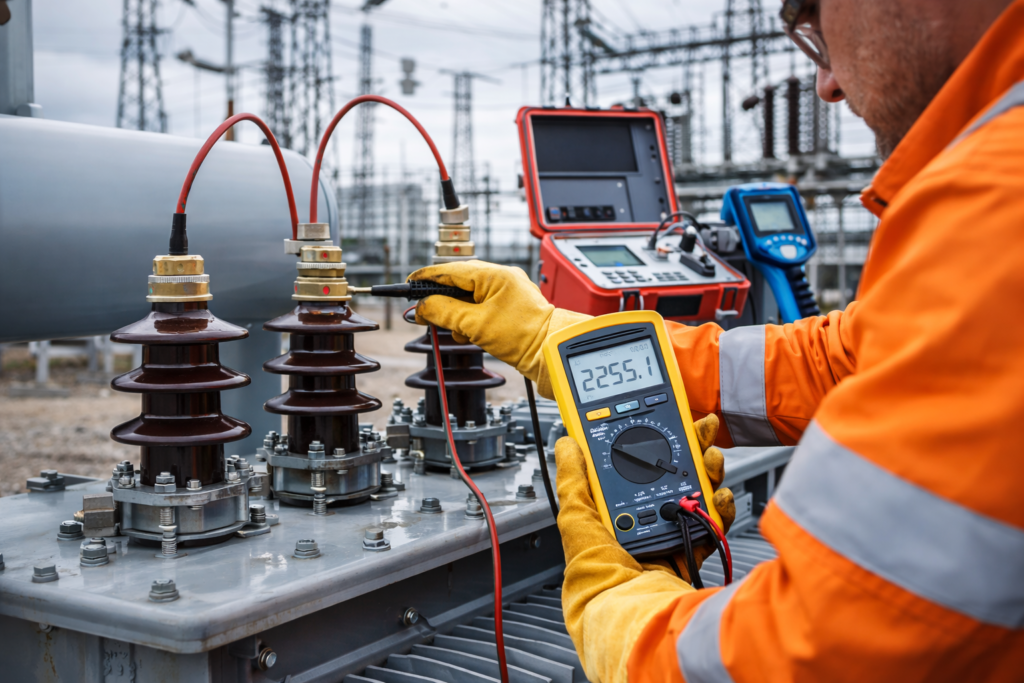
TRANSFORMERS TESTING
- Winding Resistance Test: Measures resistance of windings to identify loose connections or broken strands.
- Insulation Resistance (Megger) Test: Uses high voltage to test the integrity of insulation between windings and to ground.
- Turns Ratio (Voltage Ratio) Test: Confirms the ratio of high-voltage to low-voltage turns, ensuring proper voltage regulation.
- Vector Group / Polarity Test: Ensures the transformer’s phase relationship between primary and secondary is correct.
- Short-Circuit & Open-Circuit Tests: Determines no-load losses, copper losses, and efficiency.
- SFRA: Sweep Frequency Response Analysis (SFRA) is a sensitive, non-destructive diagnostic method used to evaluate the mechanical integrity of power transformer cores, windings, and clamping structures. By comparing current frequency response “fingerprints” against baseline data, it detects winding deformation, displacement, core movements, and shorted turns.
- Tan Delta: The tan delta test (or dissipation factor/loss angle test) of a transformer is a crucial diagnostic maintenance procedure performed at low frequencies to assess the health of insulation by measuring dielectric losses, indicating moisture, aging, or contamination. It calculates the ratio of resistive leakage current to capacitive current, with lower values (Tanδ<0.5%) representing excellent insulation, whereas values exceeding 1%-2% signify serious deterioration.
Oil Tests
- Dielectric Strength / Oil Test: Evaluates transformer oil for moisture, acidity, and dielectric strength (BDV test).
- Dissolved Gas Analysis (DGA): Detects incipient faults (arcing, overheating) by analyzing gases in the oil.